
Tbilisi seems to have two restaurant worlds running side by side. On Rustaveli Avenue and in the Old Town there are plenty of establishments with interiors designed for social media and menus that welcome foreign cards. Yet a few blocks away, residents eat in places with no English signs and no mention on traveler websites, and they pay several times less for it.
The search for Tbilisi cooking often leads to districts that few visitors ever see. Locals usually name Nadzaladevi first, to the northwest of the centre. On Tsereteli Avenue there are canteens where a full lunch costs less than 15 lari. Another district is Gldani in the northeast, built up in Soviet times. Here, in family establishments with handwritten menus on the doors, only locals eat. In the Isani and Samgori districts in the east of the city live large Azerbaijani and Armenian communities, so local cafés serve dishes rarely cooked in the centre: for example, piti, a thick lamb soup, or tiny dumplings called dushbara.
Even in the Old Town itself, if you climb the lanes from the sulphur baths in the Abanotubani area, a few family establishments have survived amid the gentrification of neighbouring streets. On Tsereteli Avenue, the independent café Machakhela serves bread with suluguni cheese that arrives almost scorching, and the smell of tkemali, sour plum sauce, served with grilled meat cuts through the street noise. On Barnov Street, off the main road, there is a courtyard café recognisable by its handwritten sign. The owner cooks three different dishes a day; on Tuesdays, if you are lucky, it may be chakapuli, young lamb stewed with tarragon. Near the bus station in the Didube district there are several snack bars for drivers and market workers. They make the city's best lobiani, bean-filled bread.
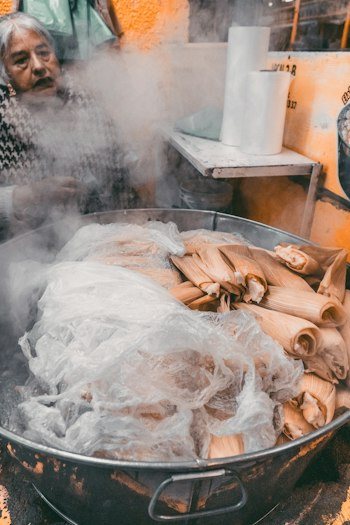
The signs of such a place are simple and reliable. There will be no English-language menu at the door, and inside there will most likely be a television showing news or football. You will have to pay in cash, but lari can be withdrawn at cash machines, which are also found in residential districts. A menu written in chalk on a board or by hand on a sheet of paper means the dishes are made from what was bought at the market that day. Finally, a basket of bread, shotis puri or corn flatbread mchadi, will appear on the table unbidden; if bread has to be ordered separately, you are probably in a tourist place.
Menus in restaurants for local residents are far broader than the familiar set of khinkali, khachapuri and mtsvadi. There you will find, for example, chikhirtma, a thick chicken soup thickened with egg yolks and flour, with vinegar and wine added. Canteens make it every day. Lobio in a pot is not a cold starter but red beans slow-cooked in clay dishes. It is served with corn bread and jonjoli, a pickled wild herb whose taste recalls capers. Chashushuli, a spicy veal stew with tomatoes and hot pepper, is the staple of home cooking but a rarity on tourist menus. Another dish you will hardly find there is muzhuzhi, a cold chicken dish in a sauce of walnuts and vinegar.
The price gap between Tbilisi's two restaurant worlds is considerable. A lunch of soup, main course, bread and a drink in a canteen in Gldani or Nadzaladevi costs 12–18 lari per person. Dinner with wine at a family restaurant in Vera or Isani costs 25–40 lari. By comparison, the same meal at a tourist restaurant in the Old Town costs 80–130 lari.
These districts are easy to reach. Both Tbilisi metro lines serve Gldani and Samgori. A ride on the Metromoney card costs 1 lari. Minibuses run from the centre to Nadzaladevi and Vera, with fares also at 1 lari. A taxi ordered through the Bolt or Yango apps will take you from the centre to Nadzaladevi for roughly 8–15 lari. It is worth remembering that many local establishments keep lunchtime hours and close at eight or nine in the evening.
Owners and staff in such places rarely speak English, but a translation app with photo text recognition will help you read the menu. Georgian tradition calls for helping a guest, so ordering by gesture or by pointing at a dish on a neighbouring table will not cause offence. A vegetarian should ask for fasting dishes, "markhvis". Thanks to the Orthodox fasting tradition, Georgian cooking has many meatless dishes: lobio, the vegetable stew adjapsandali, and pkhali, vegetable appetisers with walnuts.


Letters