
Engineers from the University of Tartu in Estonia and the Italian Institute of Technology have built a robot capable of growing itself a new functional sensor. To do this, the robot needs ultraviolet light and a special fluid that the scientists call artificial blood.
Most robots leave the assembly line with a predetermined set of components. Engineers must anticipate which sensors a machine will need and where to install them. If a robot finds itself in unforeseen conditions where it lacks some instrument, adding it on the spot is a complex technical challenge.
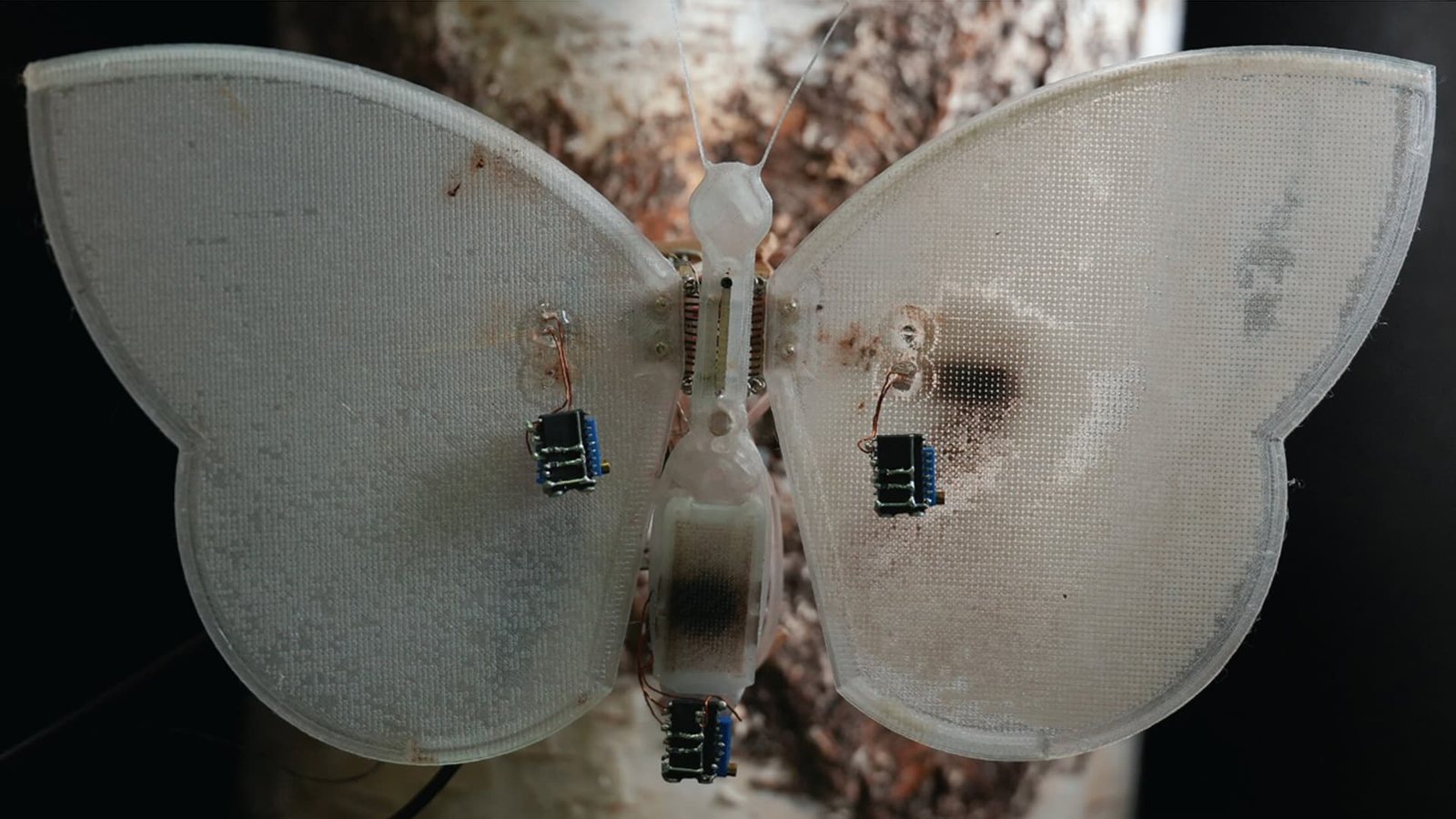
The researchers decided to test whether a robot could overcome this limitation by borrowing an idea from nature: the circulatory system. The team built a robot in the shape of a moth, resembling a blue order ribbon, a butterfly with relatively flat wings. Its transparent plastic body was 3D-printed and threaded with a network of millimeter-wide channels resembling veins. A pump circulates roughly three milliliters of fluid through them, distributing chemical components throughout the body.
I am working to give robots a circulatory system so that they can carry molecular building blocks throughout the body and create the necessary equipment on site, where and when it is needed.
— Kadri-Ann Pankratov, lead researcher on the project
To create the light sensor, the scientists filled the channels with artificial hemolymph, a fluid resembling insect blood. Its composition included pyrrole, a chemical initiator activated by light, and an additive based on cellulose. When a specific section of the body was exposed to ultraviolet light for about a minute, the pyrrole turned into polypyrrole, a polymer that conducts electricity. The transparent plastic at that spot turned black, and a new device formed on it.
The resulting sensor responds to ultraviolet light: when exposed, its electrical resistance drops. A built-in microcontroller picks up this signal, and the robot responds by flapping its wings or blinking an LED. In this way, the machine acquires an ability it did not have when it was manufactured. According to the researchers, the sensors remained operational even after four months.
So far, this is merely a demonstration of the technology. There is only one chemical reaction, and it is irreversible. In addition, the scientists themselves decided when to start the fluid flowing through the system and where exactly to grow the sensor. The robot cannot yet independently determine which component it needs. Nevertheless, in the future this approach could help machines working in forests, underwater, in collapsed buildings, or on other planets. The same system could be used to deliver substances for corrosion protection or for creating interfaces with living tissues. The results of the work were published in the scientific journal Advanced Science.


Letters