
For the first time, researchers have captured the sounds made by bowhead whales using an ordinary fiber-optic data cable. The recording was made in northern Alaska, near the town of Utqiagvik, where an internet cable runs along the ocean floor. Until now, such observations required specialized underwater microphones known as hydrophones.
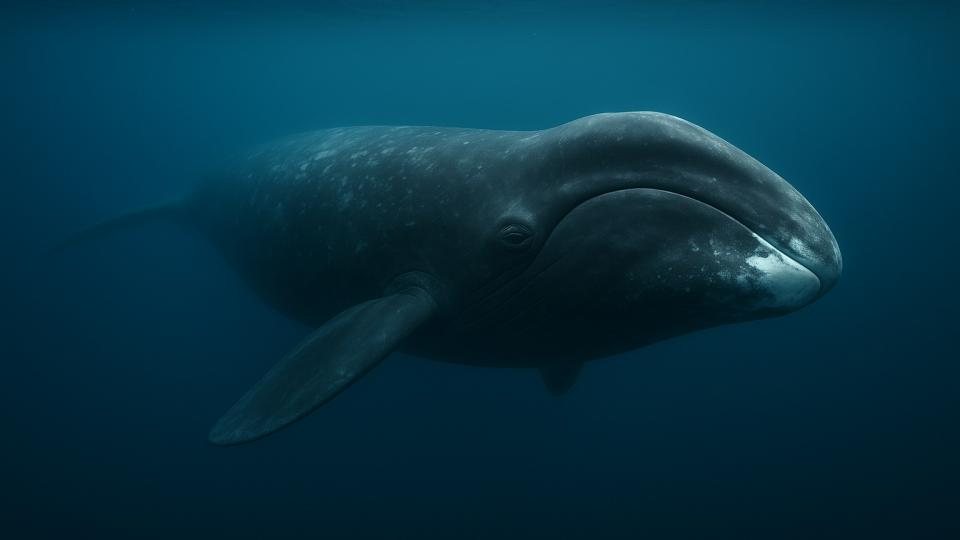
The discovery changes the way life in the ocean is studied. In the past, scientists who wanted to track whales had to mount sea expeditions and deploy expensive equipment that could easily be damaged by ice or storms. Now it turns out they can use the existing network of undersea cables, which cover the floor of the world's oceans, withstand enormous pressure and can pick up sounds that were previously beyond researchers' reach.
How a Cable Becomes an Ear
The technology that made it possible to "hear" the whales is called distributed acoustic sensing. As a sound wave travels through water, it causes microscopic vibrations in a fiber-optic cable. A special instrument on shore sends laser pulses down the cable, and these pulses reflect off the tiny deformations. By analyzing changes in the reflected light, the system reconstructs the original sound.
Until recently, the method was thought to be suitable only for detecting loud, low-frequency sounds, such as the calls of blue whales and fin whales, which communicate at frequencies below 100 hertz. Bowhead whale songs fall in a higher range, from 150 to 300 hertz; their signals are quieter and fade faster in water. A team of scientists led by Léa Bouffaut of Cornell University has shown that the technology can pick them up as well.
A Silence That Speaks
In the spring of 2026, the researchers analyzed data from a telecommunications cable operated by Quintillion off the coast of Alaska. Representatives of the Whaling Captains Association and the North Slope Borough Department of Wildlife Management also took part in the work. In the mass of data, the team found bursts of energy characteristic of the sounds bowhead whales make. The whales use these signals to communicate, to find one another and to gauge ice conditions.
The new method allows observations to be made continuously, without disturbing the animals and without spending money on maintaining underwater stations. It could be used to track whale migrations in real time and to study how their populations respond to climate change. The findings were published in the scientific journal Methods in Ecology and Evolution.


Letters