
On May 14, 2022, a radio telescope in South Africa picked up a flicker near the crowded plane of the Milky Way. First came a long pulse, then a shorter, sharper one, followed by an hour of silence. Then the sequence repeated exactly. The rhythm held for about fifteen hours, and then it stopped. Telescopes have returned to the same patch of sky many times since, but in several years they have not caught a single further signal.
A double pulse every 62 minutes
The source was given the catalog name LPT J1555−5631. It pulsed with a period of 62.2 minutes, as confirmed by ten hours of observations with the Australian telescope ASKAP. That makes it one of the so-called long-period transients, a recently discovered and enigmatic class of objects that emit long radio bursts separated by long, regular stretches of silence.
Even among these unusual objects, the new one stands out. As ScienceAlert reports, each of its cycles consisted of two distinct pulses rather than one. The main pulse lasted about 2.44 minutes, and the second, narrower one 0.66 minutes. Yet both reached almost the same peak brightness.
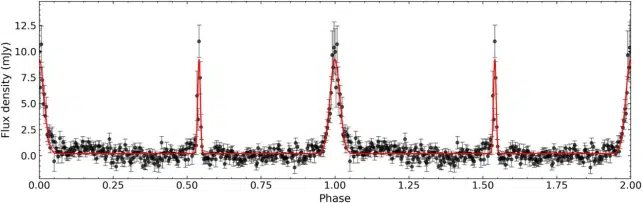
What is more, the radio waves of the two pulses twisted in opposite directions. Radio waves can have a property known as circular polarization: they can spiral either clockwise or counterclockwise. In this case, the pulses rotated in opposite directions. The short pulse was almost completely polarized, as if it came from an entirely different part of the object.
Most likely, it did. A team led by Scott Hyman of Sweet Briar College concluded in The Astrophysical Journal that the object is a nearly orthogonal rotator. That means its spin axis and magnetic axis are almost perpendicular, so both magnetic poles sweep past Earth with every rotation. One pole produces the long pulse, the other the short one.
The spacing between the pulses, however, does not quite fit this model. It came to 165.4 degrees rather than exactly 180, as one would expect from a simple two-pole magnet. Speaking to reporters, Hyman noted that this offset is an important clue: it suggests the object's magnetic field is more complex than that of an ordinary bar magnet.
A chance find in an old archive
No one was looking for this object. The team stumbled on it by accident while combing through a public archive of MeerKAT observations of supernova remnants in search of an entirely different phenomenon. The signal turned up in data that had been sitting in the archive since the day it was recorded.
It turned out that on the same day MeerKAT made its observations, the Australian telescope ASKAP was also surveying the region and caught the same source. Two observatories on different continents had recorded the same short-lived signal, and no one had any idea.
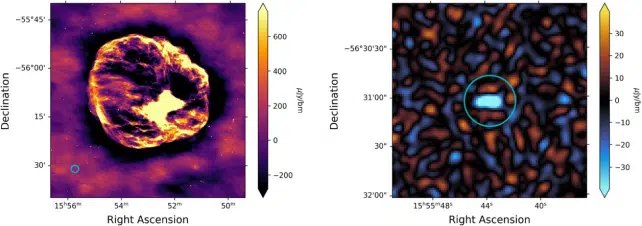
The source's location only deepens the mystery. It lies about 0.5 degrees from the center of the supernova remnant SNR G 326.3–1.8, an expanding shell of debris from an exploded star. Its distance is far less certain. The best estimate is about 5.4 kiloparsecs, or roughly 17,600 light-years, but the study's authors themselves describe it as weak.
Years of silence
Once the team knew what to look for, it went through every available record. The researchers found about 60 ASKAP observations of this patch of sky from 2019 to 2026, and only the one from May 2022 contained pulses. Eleven MeerKAT observations from 2021 and two from 2019 showed nothing. Australia's Murchison Widefield Array checked the area in June 2022, just weeks after the outburst, and likewise recorded only silence.
That means the object's period of activity was very brief. Judging by the gaps between observations, it was active for at least 15 hours but no more than 10 months.
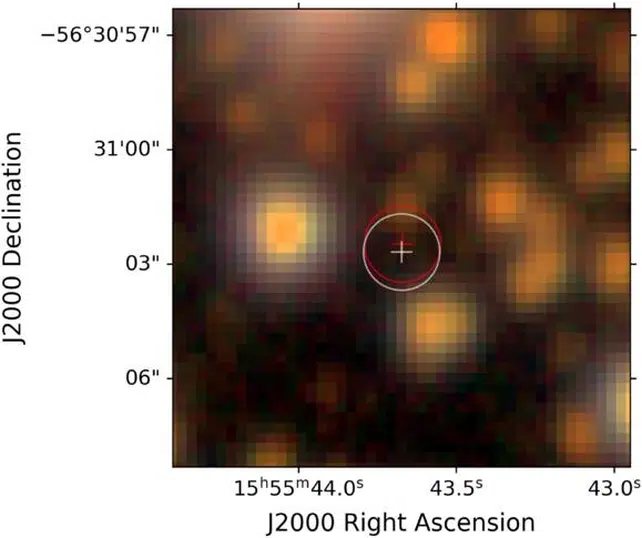
Observations at other wavelengths also came up empty. The X-ray catalogs from eROSITA, XMM-Newton and Chandra show no source at that position. The nearest visible star lies about one arcsecond away, but the region is so crowded with stars that the match is probably a coincidence. Infrared surveys turned up nothing notable either.
Two suspects, neither a perfect fit
Two main hypotheses remain. The obvious candidate is a neutron star, but a 62-minute rotation period is far too slow for ordinary pulsar emission. To produce pulses like these, its magnetic field would have to be badly distorted or have an unusually complex structure.
A white dwarf has its own problem. No lone white dwarf has ever been observed emitting radio waves like these, so it would need a companion star, and none has been found. A rotation period of 62.2 minutes is also shorter than the minimum orbital period, about 78 minutes, for the most common type of white dwarf binary.
Questions like these have dogged this class of objects since its discovery. The long-period transient category was opened by GLEAM-X J1627−5235, observed in 2018, and about a dozen more have since been found in the Milky Way. In his interview, Hyman wonders whether all of these objects are of the same type, and the new paper leaves that question open.
Hyman has watched a signal vanish before. In September 2002, he detected the source GCRT J1745−3009, which produced five radio bursts 77 minutes apart and then fell silent. He searched for it for years, without success. That source later flared up again, as did two other signals that had previously disappeared.


Letters