
In November 2024, videos of the "We Are Our Mountains" monument in Stepanakert began circulating on Azerbaijani Telegram channels. The footage also showed the back of the sculpture, which rarely makes it into photographs: the stone had been covered with first names, surnames, place names and slurs against Armenians. Damage was visible on the surrounding grounds as well. The stone man and woman still stood on their hill, but the people who came to see them had changed.
How the Monument Came to Be
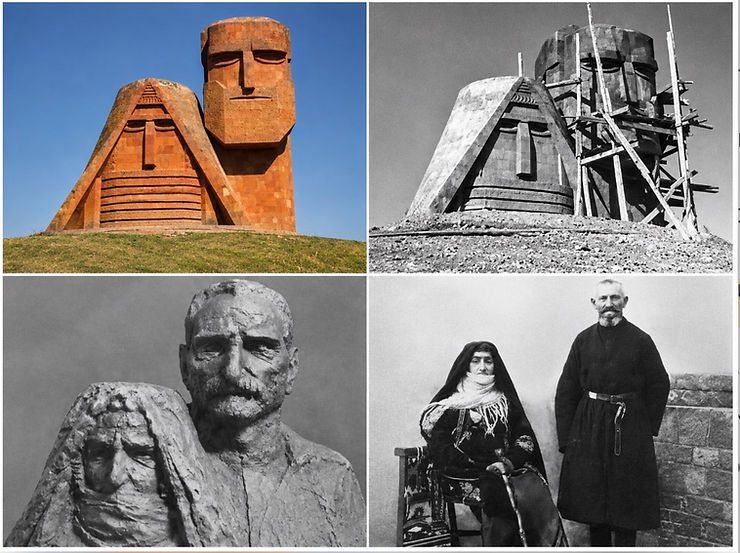
The monument, the work of sculptor Sargis Baghdasaryan and architect Yuri Hakobyan, was unveiled on November 1, 1967. At the time, Stepanakert was the capital of the Nagorno-Karabakh Autonomous Oblast within the Azerbaijan SSR. The roughly nine-meter monument was carved from reddish tuff brought from Armenia's Armavir region.
Mushegh Ohanjanyan, chairman of the regional council's executive committee, was involved in its installation. The leadership of Soviet Azerbaijan opposed the project, particularly its placement at the entrance to the city, but the monument went up regardless.
The original proposal was to put a statue of a soldier on the site. Baghdasaryan chose instead the figures of two elderly people. He already had the idea: in 1965, he had exhibited a small sculptural pair called Karabakhtsi in the Italian city of Carrara. Two years later, the same figures, now greatly enlarged, rose beside the road to Stepanakert.
According to the sculptor, the models were his own grandfather and grandmother. Baghdasaryan was born in the Hadrut district into a family of stonemasons. His grandfather, Master Baghdasar, dressed granite slabs and carved gravestones, sometimes adding an image that recalled the trade of the deceased — a pair of scissors or some other tool. His son Ivan helped him, and later his grandson Sargis joined the work as well. Years afterward, Sargis returned to the image of his grandfather, giving it form in a nine-meter monument.
The sculpture has no conventional pedestal. The man's head is lifted upward; the woman's headscarf spreads out to either side, echoing the contours of the hills. The figures' legs are not carved — they seem to continue beneath the ground. "These are the people, this is the land, this is us, our mountains," was how Baghdasaryan explained his concept. The same words are carved on the back of the monument.
Symbol and Source of Dispute
In Stepanakert, people seldom used the long name; they called the monument "Grandma and Grandpa." Newlyweds climbed the hill to have their pictures taken. The photographs in family albums show bouquets, wedding dresses, children — and behind them, two stone faces. The image later took its place at the center of the coat of arms of the Nagorno-Karabakh Republic. The sculpture became recognizable even to people who had never been to Stepanakert.
In May 2009, "Grandma and Grandpa" appeared on the Eurovision Song Contest broadcast. The monument was shown in a short clip introducing the performance by Armenia's Inga and Anush. The Azerbaijani side lodged a protest: Baku, which considered Nagorno-Karabakh its own territory, objected to a monument on that land being presented as an Armenian landmark. By the final, the clip had been edited to remove the shot of the monument.
When the jury results were announced during the final, the singer Sirusho, who was representing Armenia, held a folder with a photograph of "Grandma and Grandpa" on the back. The same image appeared on the giant screen behind her. The two faces cut from the clip were back in front of television viewers.
After 2023
On September 25, 2013, the restored monument was unveiled in Stepanakert. The work was funded by the philanthropist Karen Avagumyan. Attending the ceremony were Bako Sahakyan, then president of Nagorno-Karabakh; the sculptor's son, Ashot Baghdasaryan; and Caroline Cox, a member of the British House of Lords. People kept coming to the monument, from which roads led out to villages, to schools, to cemeteries and to the homes of relatives.
On September 19, 2023, Azerbaijan launched a military operation in Nagorno-Karabakh, calling it "anti-terrorist measures" to restore its control over the region. A ceasefire was announced on September 20. By the end of the month, more than 100,000 Armenians had reached Armenia via the Lachin road. The Office of the United Nations High Commissioner for Refugees later put the number of displaced people at more than 115,000.
People left Stepanakert in cars and buses. Left behind on the hill was "Grandma and Grandpa," at whose foot wedding photographs had been taken for so many years.
On November 17, 2023, the International Court of Justice ordered Azerbaijan to ensure the safe, unimpeded and expeditious return of people who had left Nagorno-Karabakh after September 19 and wished to go back. As early as 2021, the same court had ordered Azerbaijan to prevent the vandalism and desecration of Armenian cultural heritage, including monuments.
Whose Monument?
In August 2024, an Azerbaijani cultural publication presented the "We Are Our Mountains" monument as an example of Azerbaijan's multicultural tolerance. Another article stressed that it had been built with money from the budget of the Azerbaijan SSR. That piece listed Safi Garayev as architect alongside Baghdasaryan. Records of the National Gallery of Armenia and Armenian publications on the monument's history name Yuri Hakobyan as the architect. The Azerbaijani publication offered no explanation for the discrepancy.
The debate extended to the scarf on the woman's head: one Azerbaijani commentary claimed that her clothing was not Armenian. No one disputed who had made the monument; the argument was over whom the faces he had captured in stone belonged to.
On August 1, 2025, Gudrat Hasanguliyev, a member of the Azerbaijani parliament, called for the monument to be demolished, describing it as a symbol of Armenian nationalism and separatism. In its place, he proposed erecting a large statue of an Azerbaijani soldier. This was his own public proposal; no decision on the matter followed from the Azerbaijani government.
In November of that year, new videos spread online showing inscriptions on the front of the monument as well. In June 2026, a photograph appeared on social media whose authors claimed that heavy machinery was at work by the monument and that its demolition had already begun. Organizations dedicated to preserving the cultural heritage of Artsakh cautioned that the authenticity, location and date of the photograph had not been verified. The report of the demolition was never confirmed.
On November 1, 2026, the 59th anniversary of its unveiling, reports noted that the monument was still standing. Baghdasaryan did not set his old couple on a pedestal — he wanted them to grow out of this land. The hill is where it always was. Wedding photographs from Stepanakert still show the same two faces. Only now the albums themselves are kept outside the city.


Letters