
A 28-year-old man named Carl lives with an unusual visual distortion: he sees cat features on people's faces and human features on his cat. It began after brain surgery to remove an arteriovenous malformation, a tangle of abnormally connected arteries and veins. The lesion was located in the right posterior temporal lobe, a region that plays a central role in face perception.
As Carl describes it, people's eyes can change shape to resemble a cat's, and their pupils can dilate. He also sees shadows and textures on faces that look like patches of cat fur. At times, conversely, he notices the features of someone he knows on his cat, such as that person's eye shape and pupil size. Occasionally, one person's features are transferred onto another person's face.
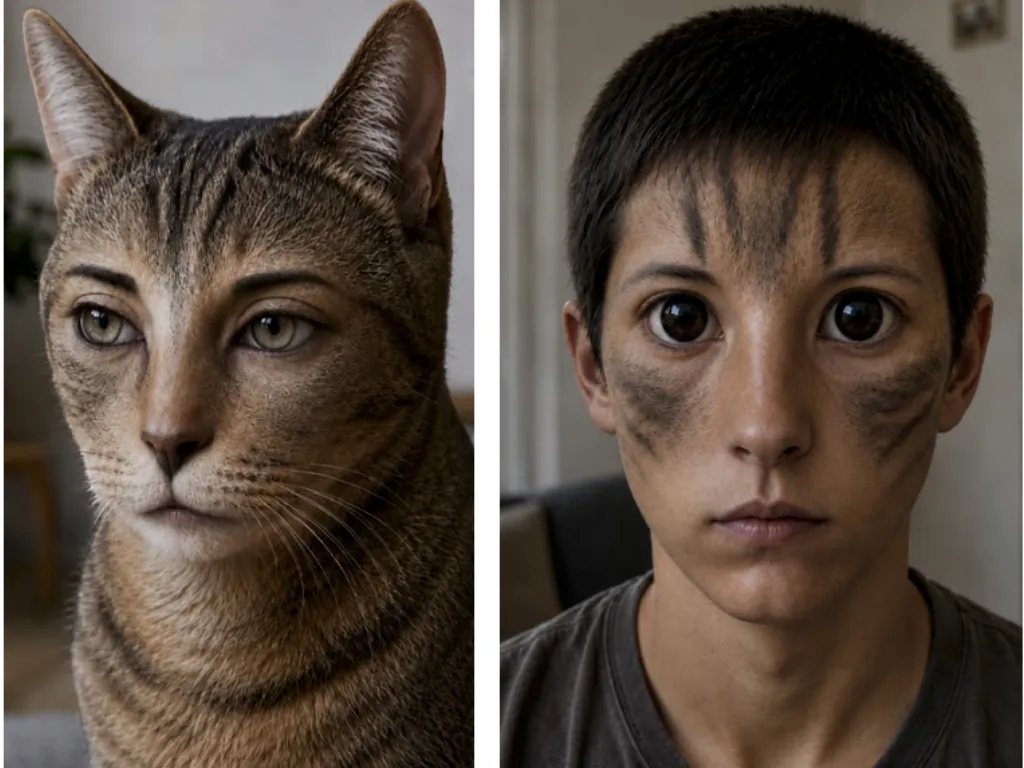
The distortions began two years ago, after the surgery. They can last several hours or even an entire day. Brad Duchaine, a professor at Dartmouth College and one of the authors of the report on Carl's case, told reporters that for the patient they have become "a normal part of life."
Professor Duchaine explains that in Carl's brain, stored memories of very familiar faces are spontaneously activated and blend with whatever face he is looking at, whether a person's or his cat's. Carl himself, according to the scientist, would like the distortions to stop but has learned to live with them. Duchaine added that for people with this kind of visual perception disorder, social interactions can be unsettling. Many do not talk about their condition for fear that they will not be believed or will be thought to suffer from more general psychiatric disorders. The report on Carl's case was published in the scientific journal Cortex.
What is prosopometamorphopsia
Prosopometamorphopsia is a disorder in which a person sees faces as distorted. According to Professor Duchaine, features can appear stretched, shifted, drooping or altered in size. The color or texture of the skin may change, and in rare cases, like Carl's, the features of one face appear on another.
The disorder usually arises after damage to, or disruption of, the brain areas responsible for processing faces, as a result of a stroke, a tumor, surgery, epilepsy or a head injury. In many cases, however, the cause cannot be determined.
There is as yet no established treatment for prosopometamorphopsia. "We are investigating stimulus manipulations that in some cases affect the distortions," Duchaine says. He notes that if the distortions are caused by an underlying condition such as epilepsy or a tumor, treating that condition may reduce them.
The duration of symptoms varies. For some people, the distortions go away within a few days or weeks; for others, like Carl, they persist for years.
A similar case 40 years ago
Carl's case is not the first in the medical literature. In 1986, researchers described the experience of a woman who, nine months after a stroke, was riding a bus and looked at a poodle sitting on another passenger's lap. When she looked away, she suddenly saw the dog's features on the faces of all the other passengers. The distortion persisted even after she got off the bus and faded only after about half an hour.
Professor Duchaine notes in the report that such transfers of features between animals and humans are rare. More often, patients with prosopometamorphopsia report distortions in the shape and position of facial features. This makes Carl's case and the earlier one especially remarkable.
Over the past five years, Duchaine says, about 300 people with distorted face perception have contacted his research group through its website. The scientists would like to hear from others who have experienced similar phenomena in order to continue studying the condition.


Letters