
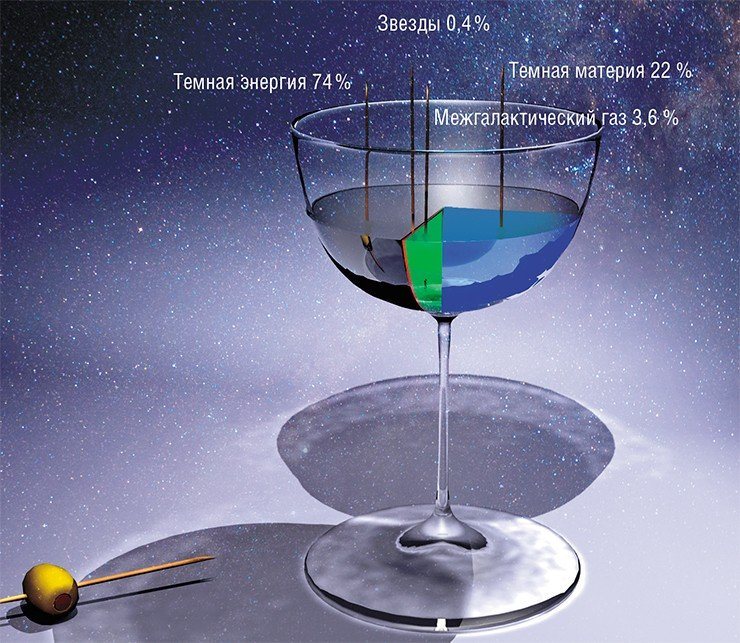
According to current thinking, ordinary matter accounts for less than 5% of everything in the cosmos. The remaining 95% is dark matter and dark energy. They are called "dark" because they neither emit, absorb nor reflect light, and their existence can be inferred only from indirect evidence. These invisible components are believed to play a decisive role in the structure and evolution of the universe.
How It All Began
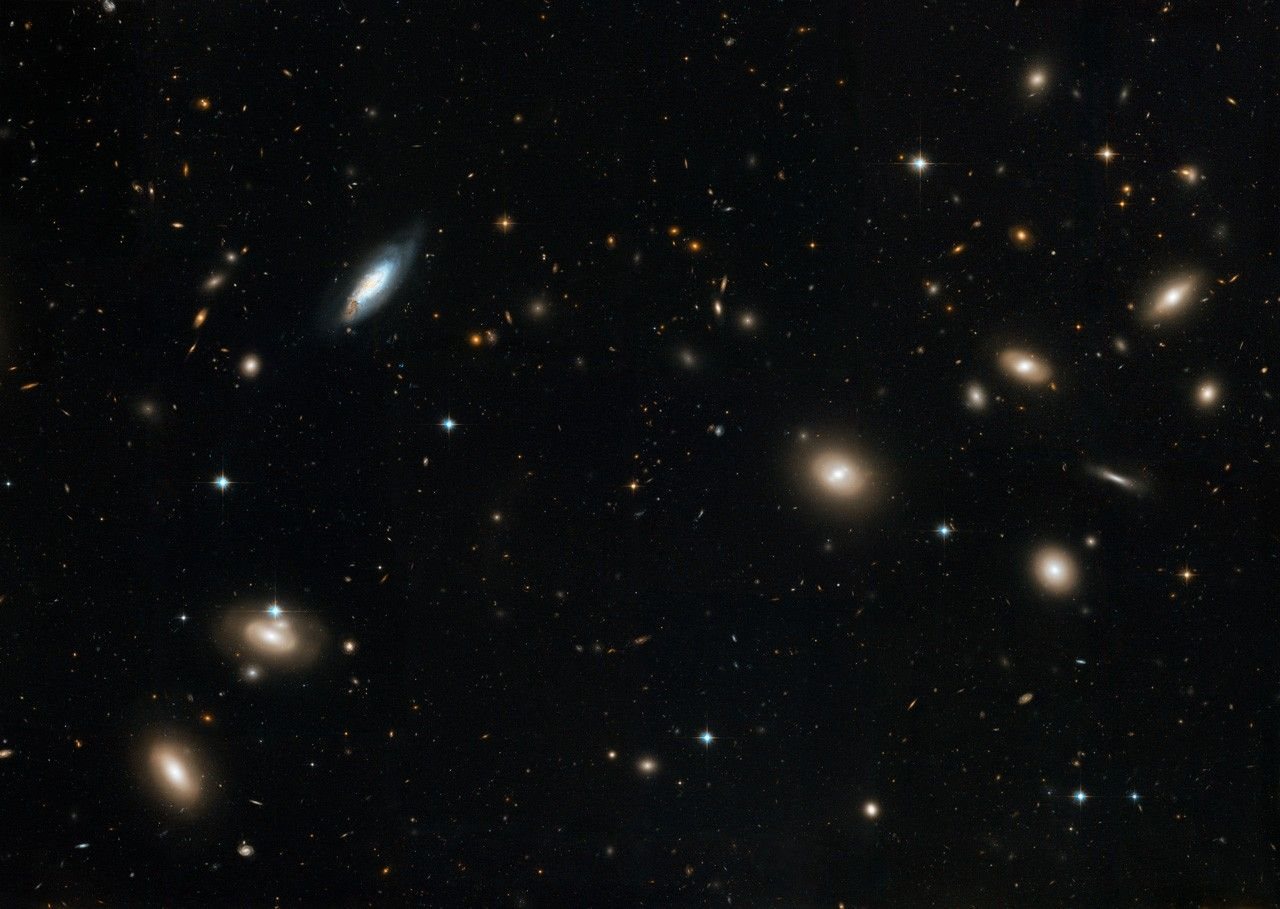
The first to speak of invisible matter was the astronomer Fritz Zwicky. In 1933, while studying a cluster of galaxies in the constellation Coma Berenices, he noticed that the combined mass of all its stars was not enough to hold the galaxies together by gravity. The galaxies were moving so fast that they should long ago have flown apart, yet for some reason they remained in the cluster. Zwicky proposed that they were held together by some kind of "missing mass."
In the 1960s, the astronomers Vera Rubin and William Kent Ford found fresh evidence. They analyzed the light of stars in spiral galaxies, beginning with the Andromeda Nebula. The stars in a galaxy's disk revolve around its center. Using a spectrometer, an instrument for analyzing light, and the Doppler effect, the scientists measured how fast the stars were moving. The Doppler effect means that light from an approaching object is shifted toward the blue end of the spectrum, and light from a receding one toward the red. The size of the shift makes it possible to calculate the speed.
The astronomers expected stars on the outskirts of galaxies to move more slowly than those closer to the center, where most of the visible matter is concentrated. That is how the planets of the solar system behave: the farther a planet is from the Sun, the lower its speed. But Rubin and Ford's measurements showed that stars on the periphery of galaxies move almost as fast as those near the center. The gravity of the visible matter was not enough to keep them in their orbits. This meant that the outer regions of galaxies must contain a substantial invisible mass supplying additional pull.
After studying many galaxies, the scientists were convinced that the phenomenon was universal. Calculations showed that galaxies contain roughly ten times more dark matter than visible matter. Thus at least 90% of the mass of the universe remains invisible. Most of it is thought to be concentrated in vast spherical "halos" surrounding galaxies.
Back in the 1920s, the astronomer Edwin Hubble discovered that galaxies are moving away from one another, and that the farther away a galaxy is, the faster it recedes. This observation became the foundation of the theory of an expanding universe. Then, in 1998, precise measurements showed that the expansion is not slowing under the influence of gravity but, on the contrary, accelerating. This gave rise to the idea of an unknown force that counteracts gravity and "pushes" the universe apart. That force was named dark energy.
Dark Matter
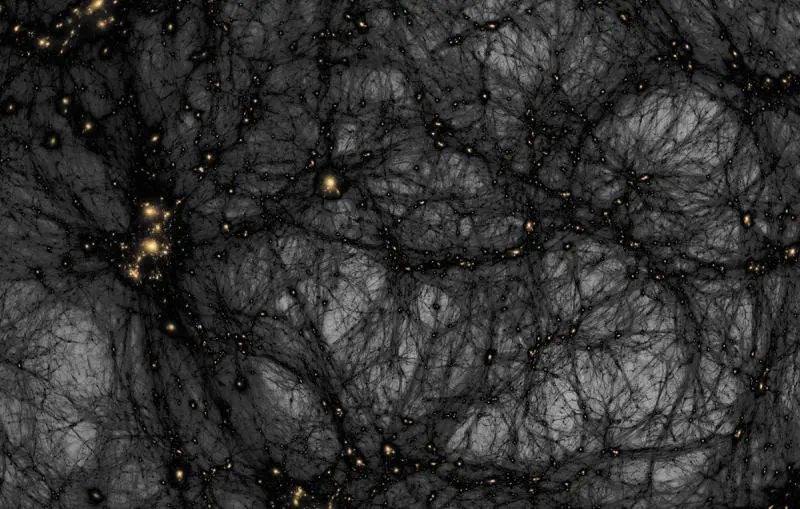
Dark matter is a hypothetical form of matter that does not interact through electromagnetic forces and reveals itself only through gravity. What it is made of is unknown. The main hypotheses divide it into "cold" and "warm." Cold dark matter, according to theory, consists of heavy, slow-moving subatomic particles. Warm dark matter, by contrast, consists of light, fast-moving ones.
Liang Gao and Tom Theuns used a computer to simulate how these two kinds of matter evolved in the early universe. In both models, matter first formed threadlike networks. Then, according to the scientists, the dark matter turned into bubbles: the fast-moving particles stretched into thin, dense filaments that attracted ordinary matter, forming stars. In the cold-matter model, these bubbles kept their structure, and large stars formed at their centers. These burned out quickly and exploded, enriching the universe with heavy elements for later generations of stars.
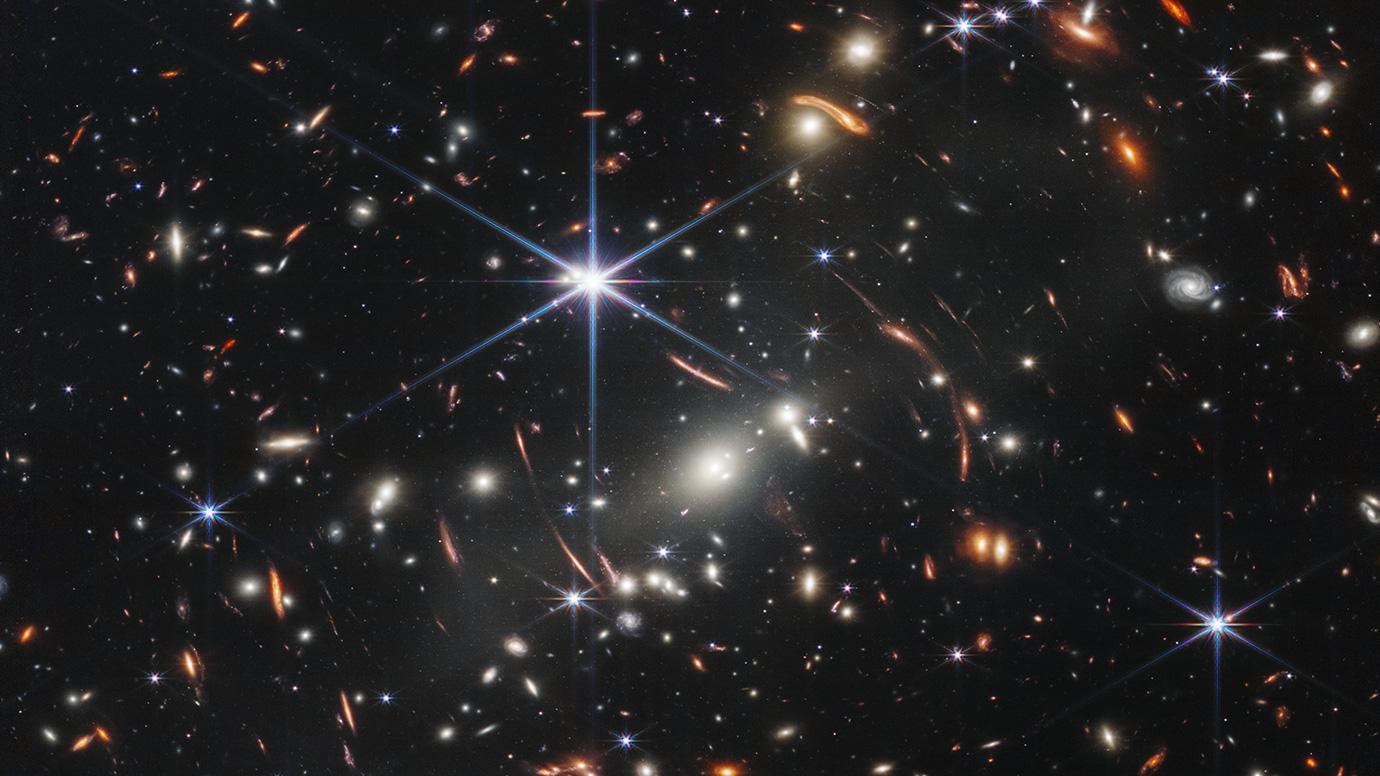
The existence of dark matter is also supported by observations of gravitational lensing. This is the phenomenon in which massive objects warp space with their gravity and, like a lens, distort the light from more distant sources. Observing the Bullet Cluster, which formed when two clusters of galaxies merged, the Chandra X-ray Observatory recorded that the hot gas (ordinary matter) slowed down in the collision. Yet the total mass of the clusters remained unchanged, indicating that most of it consists of invisible dark matter.
Candidates for dark matter particles include hypothetical weakly interacting massive particles (WIMPs) and axions. Scientists had hoped to detect them at the Large Hadron Collider: if such particles were produced in collisions, they would escape the detectors unnoticed, carrying off some of the energy. Their existence could then be inferred from the missing energy, but no such results have yet emerged. There are also alternative theories, such as modified Newtonian dynamics (MOND), which suggests that the law of gravity itself may work differently on large scales.
Dark Energy
Dark energy accounts for about 68% of the total mass-energy of the universe. It is thought to be evenly distributed through space and time. It exerts no gravitational influence on individual objects but acts on the universe as a whole, creating a repulsive force and accelerating its expansion.
One of the most widespread hypotheses links dark energy to the energy of the vacuum. Albert Einstein himself introduced this idea into his equations as the "cosmological constant," in order to describe a static universe. When it turned out that the universe was expanding, he called the constant his mistake. In modern cosmology, however, the concept has been reinterpreted. The problem is that calculations of vacuum energy based on quantum theory yield a result that differs from the observed value by many orders of magnitude.
Another theory, known as "quintessence," holds that dark energy is not a constant but a kind of field pervading the universe that can change over time.
Then again, dark energy may not exist at all. Scientists at the University of Canterbury in New Zealand recently suggested that the observed acceleration is merely an illusion. After analyzing data on supernovae, they concluded that the universe may be expanding unevenly. In their model, gravity slows the passage of time, which makes it appear to us that distant objects are receding at an accelerating rate. As Professor David Wiltshire argues, what we take to be dark energy may be a misinterpretation of changes in the kinetic energy of expansion. New data expected in the coming years may help solve the puzzle.


Letters