
The story of the dinosaurs' extinction, long attributed to the impact of a single giant asteroid, has taken a new turn. Scientists have confirmed the existence of a second impact crater from the same period. It lies on the ocean floor off the coast of West Africa and has been studied in detail using seismic scanning. The discovery suggests that at the end of the Cretaceous period the Earth may have collided with at least two massive celestial bodies rather than one, as was previously believed.
What Was Found on the Atlantic Floor
The unusual structure on the seabed off the coast of Guinea was first noticed back in 2022, but at the time it could not be examined in detail: the object lies beneath a 300-meter layer of water and seabed sediment. In 2024, an international team of researchers published the results of a three-dimensional seismic survey in the journal Nature Communications. Using sound waves sent through the Earth's crust, the scientists obtained a clear image of the crater hidden beneath the silt.
The formation is almost perfectly circular, with a diameter of 9.2 kilometers. According to the researchers, the characteristic deformation of the rock and the faults on the seabed confirm its impact origin. The crater, named Nadir, was left by a space body about 450–500 meters across, traveling at roughly 72,400 kilometers per hour. It struck around 66 million years ago, in the same geological epoch as the Chicxulub asteroid impact on the Yucatán Peninsula.
The Aftermath of the Impact
Although the Nadir crater is far smaller than Chicxulub, which measures as much as 180 kilometers across, its impact set off catastrophic events. By the researchers' calculations, the collision with the ocean surface generated a tsunami more than 800 meters high. It swept across the Atlantic, crashing onto the coasts of present-day Africa and South America. The impact also triggered powerful underwater landslides and local earthquakes that reshaped the ocean floor for hundreds of kilometers around.
Coincidence or a Double Strike
The key question for scientists is whether the asteroids that left the Chicxulub and Nadir craters were connected. Several explanations are being considered. A single large asteroid may have broken apart under the pull of the Earth's gravity, or after colliding with another object in space, and its fragments fell at different points on the planet a short time apart. Another theory holds that the Earth passed through a cluster of space debris, resulting in several impacts. Simple coincidence cannot be ruled out either: two independent asteroids striking in the same geological period.
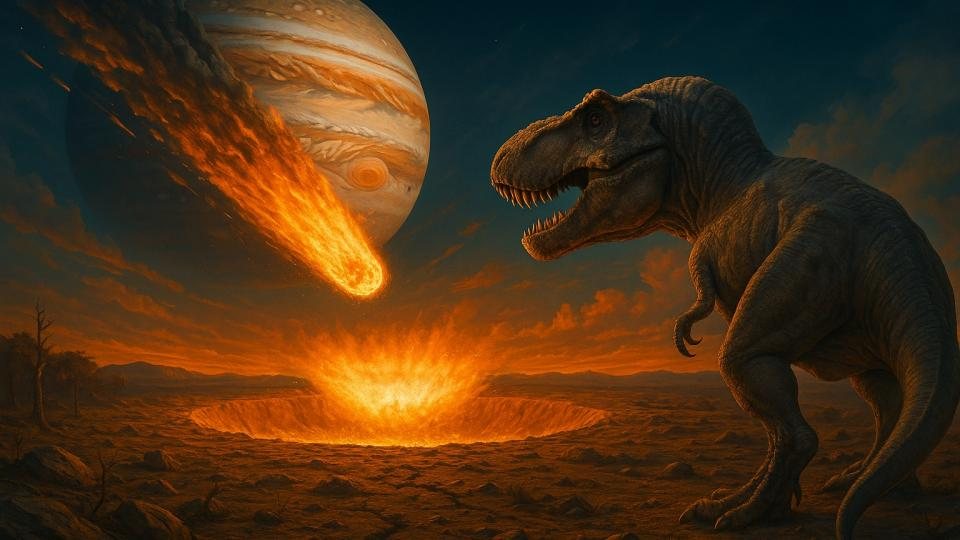
If the hypothesis that a single body broke apart is confirmed, astronomers will have to revise their assessment of the asteroid threat to the Earth. The researchers plan to begin drilling in the area of the Nadir crater to obtain rock samples. Analyzing them will help establish the exact time of the impact and settle once and for all whether the second asteroid was part of the same event as the Chicxulub strike.


Letters