
On November 4, the History Museum of Armenia opened the exhibition "The Nebra Sky Disc: Star Frequencies." For the first time, Yerevan is hosting an official replica of the artifact, which is more than 3,600 years old. The original disc is listed in UNESCO's Memory of the World Register of documentary heritage.
Speaking at the opening, David Poghosyan, director of the History Museum of Armenia, said the event marks a new stage in cooperation between Armenian and German museums. "It is a great honor for us to host this exceptional event in our flagship museum. It matters for the cultural life of Armenia as a whole," he said. The exhibition, the director noted, brings together science, art and museum display.
Claudia Busch, Germany's ambassador to Armenia, spoke of the enduring bond between humanity and the cosmos. She stressed that fascination with and curiosity about space endure in people regardless of their origins, affiliations or faith. Beyond its intellectual value, the ambassador added, the exhibition is an important sign of thriving Armenian-German relations.
The director of the Goethe-Institut said the Star Frequencies project embodies the goals of the institute's work in Yerevan: curiosity, openness, exchange and the courage to change one's perspective. "We look at the stars, and in doing so we speak about ourselves, about our shared responsibility and our future," he said. The institute, he explained, aims to create an open space in Yerevan where people from Armenia and Germany can meet, learn from one another and create something new together. The project begins in Armenia and will then continue in Germany.
A Detective Story and a Scientific Treasure
Professor Harald Meller, director of the State Office for Heritage Management and Archaeology of Saxony-Anhalt, recounted the dramatic story of the disc's discovery. In 2002, he personally led the operation to recover the artifact from the black market.
The story of the disc's discovery could be told as a puppet show. In 1999, looters found the disc with a metal detector. Because they had no idea what they were dealing with, the disc still bears scratches: they tossed it into a trash can and tried to clean it with steel wool.
— Harald Meller
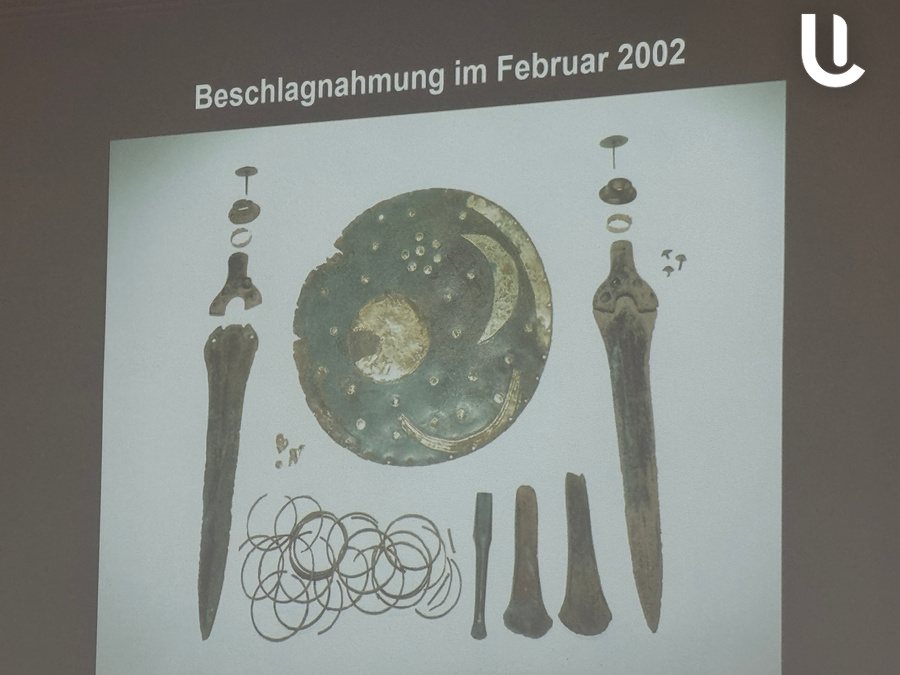
Meller added that during the seizure in February 2002, the swords and bracelets found along with the disc were broken. He wrote down the entire criminal saga himself, and it has since been made into films several times. "It was the kind of experience I would not want to go through a second time," the professor said.
Turning to the disc's scientific value, Harald Meller observed that people have gazed at the sky for millennia, yet archaeologists remain puzzled as to why it was never depicted anywhere else the way it is on this disc. Egypt has images of constellations, he said, but nowhere is there such a dispassionate, scientific representation of the sky. The disc looks simple, but it is "hypercomplex." Meller recalled presenting it to several Nobel laureates in physics at CERN, the European Organization for Nuclear Research, who told him: "Harald, you know, one of us made this — but we don't mean any of our contemporaries."
The professor also shared a story connected with space. The German astronaut Maurer approached him with the idea of taking a small replica of the disc into orbit. A plastic copy weighing less than two grams was made especially for the purpose. There is footage showing the disc floating inside the spacecraft against the backdrop of Earth, "returning to its natural environment."
Bronze Age "Globalization"
Harald Meller also spoke about the origins of the disc's materials. The gold and tin were brought from Cornwall, a peninsula in southwest England, the copper from the Alps, and the knowledge from the East. This, he said, shows how knowledge spread at the time and how humanity moves forward when it works without borders. "There were no borders in the Bronze Age," he concluded.
The exhibition is accompanied by Enigmata, a sound installation by the Armenian composer Vardan Harutyunyan. A cosmic allegory, it uses sound to create an environment that invites visitors to reflect on the bond between the heavens and humanity and on the mysteries of the cosmos.
The exhibition will be open to the public through November 29, 2026.


Letters