
Scientists have discovered a new species of giant water lily, named Victoria colombiana, in the Inírida River in northeastern Colombia. It is the first new species identified in the genus Victoria in a hundred years. A paper describing it has been published in the scientific journal Phytotaxa.
A chance photo
Five years ago, Carlos Magdalena, a botanist at the Royal Botanic Gardens, Kew, in Britain, came across a social media photo of a water lily from Colombia's Inírida region. The photographer, the American plant collector Jeremy Harris, believed he had captured the well-known Amazonian water lily. But Magdalena, who has studied these plants for many years, noticed something that didn't fit: the known species of the genus do not grow in the basin of the Orinoco, to which the Inírida belongs. The ecosystems of the Orinoco, South America's third-longest river, differ from those of the Amazon.
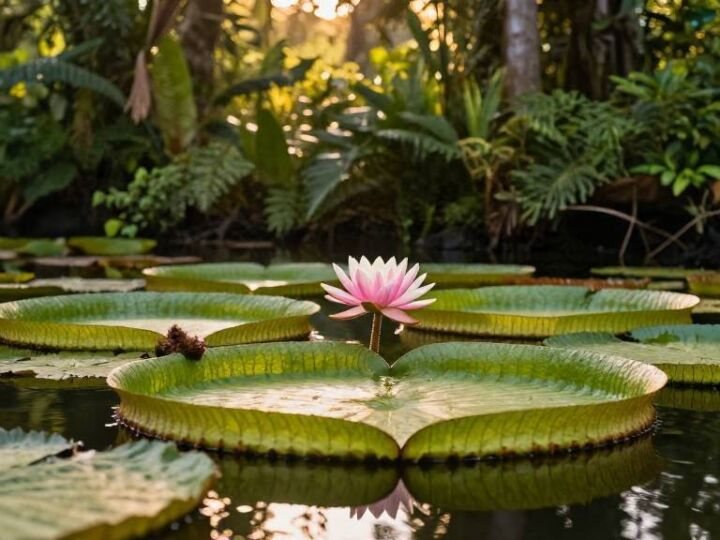
The botanist suspected that the photo showed a species unknown to science. To test his hypothesis, he studied satellite images of the area and spotted the round outlines of lily pads on one of the lakes. Harris confirmed that these were the very plants local guides had shown him.
An expedition and a race against the night
Magdalena contacted Mauricio Bernal of the Bogotá Botanical Garden. Together they arranged to work with representatives of three Indigenous reserves. Local residents, among them Nilo Rodríguez, said they had known about the big lilies since childhood but had seldom seen them in recent years. Organizing the expedition took nearly two years.
For five days the team searched for the plants, traveling by river. In the end they found two specimens, but neither was in flower. A flower is essential for making a herbarium specimen, a dried plant that serves as the reference for a scientific description. Heavy rains had raised the water level, and the expedition was on the verge of failure.
At 11 p.m., ten hours before the flight home, the expedition's boatman, Gustavo Melo of the Tukano community, said he knew where to look. At 1 a.m. the team set off into the darkness across the flooded forest, putting their trust in their guide. Shortly before dawn they reached a small lake deep in the jungle and found five more water lilies, one of them in bloom. The scientists managed to collect their material and make it back in time for their flight.
A species on the brink
After the expedition, analysis of satellite images led to another lake where the water lilies might be growing. Scientists now estimate the species' total population at 30 to 50 mature plants. The researchers are preparing documentation to have Victoria colombiana classified as critically endangered by the International Union for Conservation of Nature.
One option under consideration is establishing an additional population of the water lily in a more accessible lake within an Indigenous reserve. That could support local ecotourism and safeguard the species against extinction in the event of a natural disaster. The next step will be to collect seeds and grow the plants at the botanical gardens in Bogotá and at Kew in order to study their biology.
Maarten Christenhusz, a taxonomist who took part in describing the species, noted that new species are found all the time, but they are rarely so large that they can be seen from space. A plant familiar to local people remained unknown to science for decades because no one had compared it with herbarium specimens.


Letters