Monday, 16 November 2026Issue of 15 November
Georgiap. 4 of 12

Two Names for One Bridge. The Story of Tbilisi’s Main Crossing
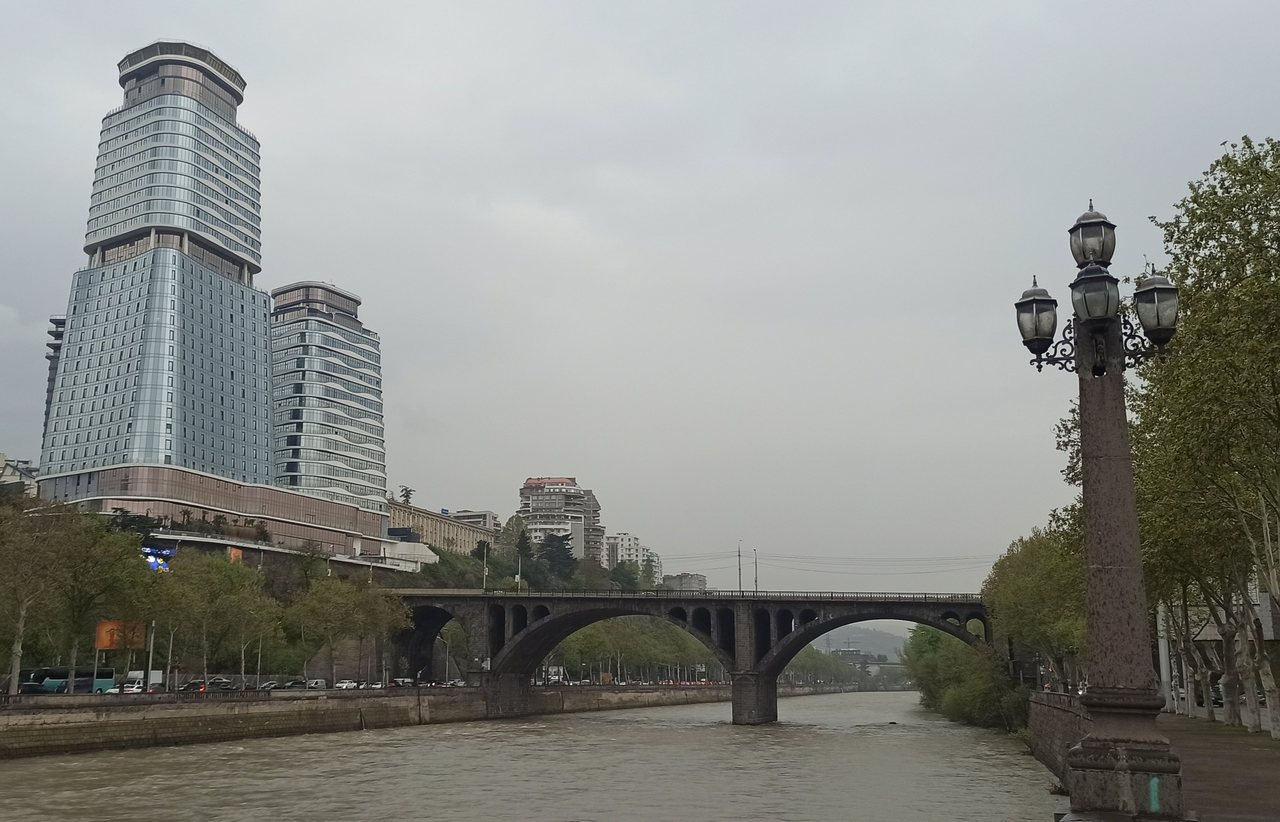
Queen Tamar Bridge over the Kura. Photo: Surprizi, Wikimedia Commons, public domain

In the early twentieth century Tbilisi was growing fast, and the city needed a new crossing over the Kura to link the Didube and Chugureti districts with Heroes Square and the Vake-Saburtalo area. The site for the future bridge had difficult terrain with steep rocky slopes. Construction, which began in 1931, became part of a large reconstruction of the city. The engineers had not only to build the bridge but also to lay approaches to it by cutting their way through the solid rock.

The work was completed in 1935. The project, led by the engineers Kiriak Zavriev and N. Slovinsky and the architect Nikolai Severov, required bold engineering solutions for its time. The rock, for example, was actually cut with a powerful high-pressure jet of water. When construction was finished, a test was held: loaded trucks, rollers and trams were driven onto the bridge, while its builders stood underneath. The structure easily withstood the load.

The bridge got its first name in honor of one of the most famous events in the Soviet Union. In February 1934 the Soviet steamship Chelyuskin, crushed by ice, sank in the Arctic. The rescue of 104 members of its crew and expedition from a drifting ice floe became news across the whole country. On April 16, 1934, a plenum of the Tbilisi city council officially named the new bridge after the Chelyuskinites.

The crossing immediately became an important part of the transport system, including the city’s tram network. In 1989 the bridge was given a new name, Queen Tamar. It still remains one of the city’s main arteries today, linking the right and left banks of the Kura. Its structure carries heavy traffic every day, and the city carries out regular work to keep it in good condition. Older residents still call it Chelyuskintsev Bridge.


Georgian Wine to Get Banknote-Grade Protection Against Fakes

A bottle of Georgian red wine
Photo: Vyacheslav Argenberg, Wikimedia Commons

Georgia’s Ministry of Agriculture has approved new labeling rules that take effect on February 1, 2027. Every bottle will get a stamp with three levels of protection. The first is a visible symbol of the National Wine Agency. The second is a hidden element read by special scanning equipment. The third is a forensic marker that lets experts confirm authenticity through chemical analysis.

The stamps will be made of self-destructing material so that they cannot be peeled off and reused. The requirement will apply not only to bottled wine but also to bulk wine, in which case the tanks will be labeled. By scanning the QR code on the stamp with a smartphone, a buyer will learn everything about the wine and its producer.

Deadline Approaches for Foreigners to Get Work Permits in Georgia

Construction workers in hard hats
Photo: sol, Unsplash

Since March 1, 2026, a work permit has been mandatory for all foreign citizens working in Georgia, wheth­er they are employed or self-employed. For those already registered in the agency’s electronic records system by that date, the law provides a transition period that expires on January 1, 2027, in just a few weeks.

The State Employment Support Agency advises employers to start preparing the necessary documents well in advance, since getting a permit from the agency can take up to 30 calendar days to process. Applying on time, the agency stresses, will help avoid fines, which under the law apply both to the employer and to a foreign employee working without a permit. The agency urges employers not to leave the paperwork until the last weeks of December.

The agency issues work permits for a period of six months to one year. Information technology workers can obtain one for up to three years. The standard 30-day procedure costs 200 lari, about $75. Expedited processing within just 10 days costs 400 lari, about $150.

Money Transfers From Russia to Georgia via Zolotaya Korona Are Available Again

A golden crown among red roses
Photo: Marek Studzinski, Unsplash

Money trans­fers from Russia through the Zolotaya Korona system are once again available in Georgia. The news agency TASS reported this.

When the money is sent, the system warns that in Georgia a transfer can be collected only at TBC Bank, either in cash at one of its branches or credited to an account at the same bank.

Previously, Zolotaya Korona trans­fers could also be collected at Bank of Georgia and at microfinance organizations.

Advertisement

Advertiser: NanoPies OÜ