Monday, 16 November 2026Issue of 15 November
Sciencep. 8 of 12

Chinese Silk Older Than the Silk Road Is Found in the Kazakh Steppe
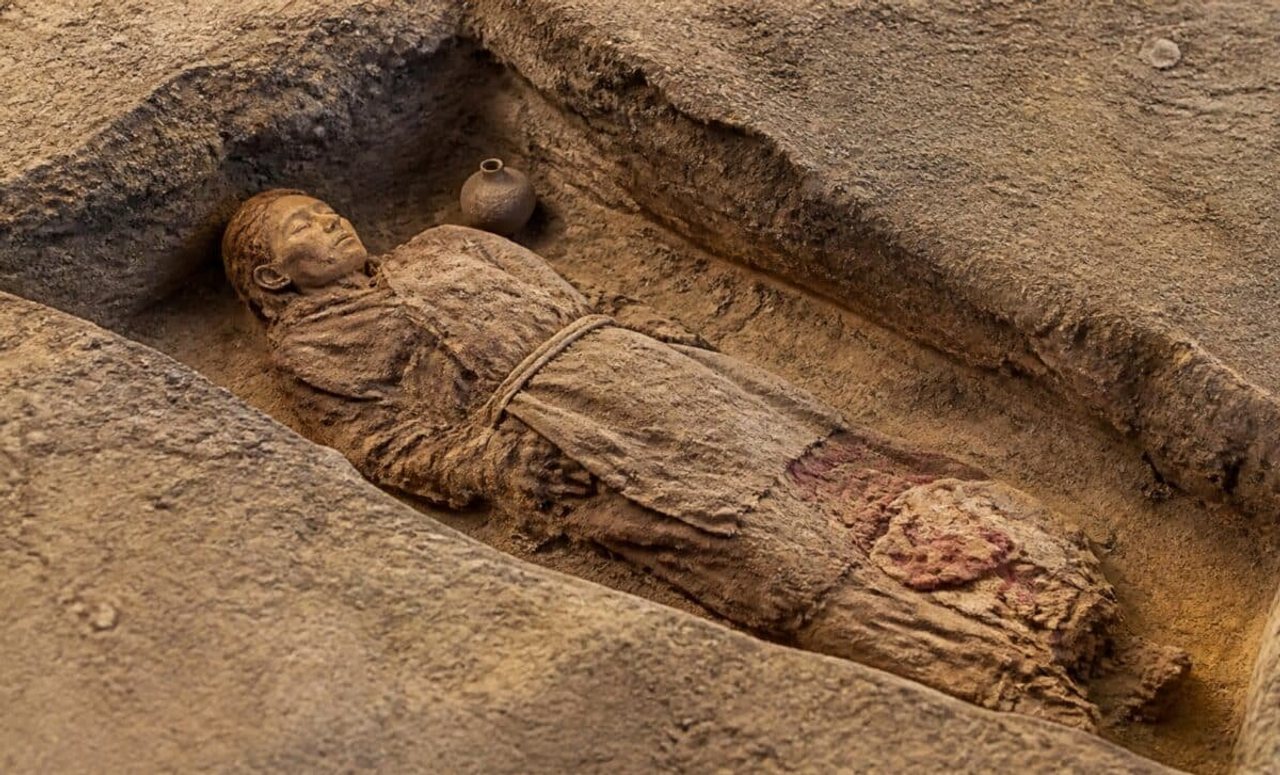
A burial in the Kazakh steppe
Photo: Zhenzhen Ma et al.

The fragment of silk was found in the Karatuma burial ground in the Almaty region. The grave of a woman aged 18 to 25 dates from the fifth to the third century B.C. The tiny scrap, 8 by 5 centimeters, lay roughly in the center of the grave, 30 to 40 centimeters from the bones of her arm and leg, and, archaeologists believe, was part of her clothing. Over the centuries underground the fibers decayed and mineralized, but conservators were able to make out a simple plain weave. Darkened and fragile, it was almost indistinguishable from the surrounding earth.

The fabric was confirmed as silk by specialists from China’s Shaanxi province and Kazakhstan’s Issyk museum-reserve. A team led by Zhenzhen Ma examined the sample with microscopes and chemical analysis. The results showed that the fabric was woven from tussah silk, produced by a wild silkworm that lives in China and feeds on the leaves of oak trees, unlike the domesticated silkworm raised on mulberry trees.

The history of the Silk Road is usually said to have begun in the second century B.C., when an envoy of China’s Han dynasty, Zhang Qian, established ties with Central Asia. By then the fabric from Karatuma had already lain in the ground for several gen­er­a­tions. The find suggests that Chinese goods moved across the Eurasian steppes long before official contacts. There was probably an early, informal exchange network, known as the Steppe Silk Road. The little scrap may have been someone’s gift or passed through several owners before reaching its last.

The find echoes another one made decades earlier in the Altai Mountains. In the burial of a Pazyryk woman known as the Ukok Princess, a shirt of wild silk was found. The origin of that fabric was long disputed. Now that the Karatuma silk has been identified as Chinese, the comparison now has firmer ground. Two items from the same period, found in different parts of the vast Eurasian steppe, suggest that wild silk was more widespread in the region than thought.

Perhaps the most personal detail of the study has nothing to do with trade routes. The fabric bears traces of repair: two different kinds of stitches. This means the garment was valued, cared for and worn in life, not made specially for the burial. Someone had carefully mended it before it went into the ground.

The Giant Crane Grus primigenia, Thought to Be Extinct, Turns Out to Be a Larger Version of Living Birds

Two cranes in a field
Photo: sharkolot, Pixabay

The idea of an extinct species arose in the nineteenth century, when unusually large crane bones were found in France. The French biologist Alphonse Milne-Edwards, who studied them, described a new species. That view went unchallenged for a century and a half.

Recently, scientists from Bourne­mouth University led by Professor John Stewart extracted and studied DNA from 18 bones found in different parts of Europe. The genetic material proved identical to that of the modern common crane, a species that is still alive and well today. The earlier conclusions rested only on bone size, which may be explained by different living conditions in the past. The common crane still nests across northern Europe.

Scientists Trace Acute Myeloid Leukemia Decades Before Diagnosis in Old Blood Samples

Acute myeloid leukemia, an aggressive blood cancer, often begins decades before symptoms appear. Researchers from Cambridge and University College London have found that in two-thirds of cases the first mutation leading to the disease arises when a person is still young. Their work was published in the journal Nature. In Britain, where the study was done, about 2,700 people develop the disease each year, and only one in six survives five years after diagnosis.

The scientists studied blood samples that about 50,000 women gave every year for eleven years for a British health study. They analyzed samples from 47 women who later developed leukemia and compared them with samples from healthy participants. Some samples had been taken 15 years before diagnosis. Ultra-sensitive DNA sequencing showed when each mutation arose.

It turned out that after the first mutation, which occurred in youth, cells carrying it multiplied slowly for decades. Each following mutation sped up growth two- to threefold, until cells with four mutations began doubling within a few weeks. The growth of these groups of cells, or clones, a condition known as clonal hematopoiesis, followed a constant rate. According to the study’s leader, Jamie Blundell, this makes it possible to predict how much a clone will grow over the years.

A few years before diagnosis, in at least a third of cases, one of the clones began to dominate the blood. Nothing of the kind was seen in healthy women. This high-risk sign is often missed in standard tests, where the mutations are mistaken for inherited ones. The scientists believe that even a small slowing of such a clone’s growth ten years before the disease could greatly reduce the chance that it develops.

Begins on p. 1

A Ship Seized by Pirates in 1721 Is Found off Madagascar

The historian Denis Piat also describes it in his book on the pirates and privateers of Mauritius. In today’s money it could be worth more than $138 million. The viceroy was later released for a ransom, but the fate of the archbishop and of the two hundred enslaved people from Moz­am­bique aboard the ship remains a mystery: nothing is known of them after the pirates divided the spoils.

The pirates took their prize 650 kilometers to Madagascar to divide the spoils. The identification, Clifford says, “is supported by multiple lines of evidence”: analysis of the ship’s underwater remains, historical records and artifacts. Among the ballast stones that steadied the ship, divers found wooden frames and religious objects probably made in Goa: wood and ivory figurines, including one of the Virgin Mary, part of a crucifix and a bone plaque with the gold letters “INRI,” the Latin abbreviation of “Jesus of Nazareth, King of the Jews.” Divers raised gold coins with Arabic script and fragments of Chinese porcelain. More than 3,300 artifacts have been recovered, and many more still lie buried under the sand.

Île Sainte-Marie was a convenient pirate base thanks to sheltered anchorages near the sea lanes and the absence of colonial rule. According to Clifford, seven to ten ships were wrecked or scuttled off the island during the golden age of piracy. The researchers estimate that its harbor holds the remains of at least four pirate ships or their prizes. Silt and sand hamper further work, and the divers can only clear the wreck slowly. Agostini believes archaeologists long overlooked the island: “Ideally, future fieldwork will lead to a deeper analysis of the many ships that sank here.” Sonar scans show the wreck resting on layers of silt.