Berrío Paints With Paper
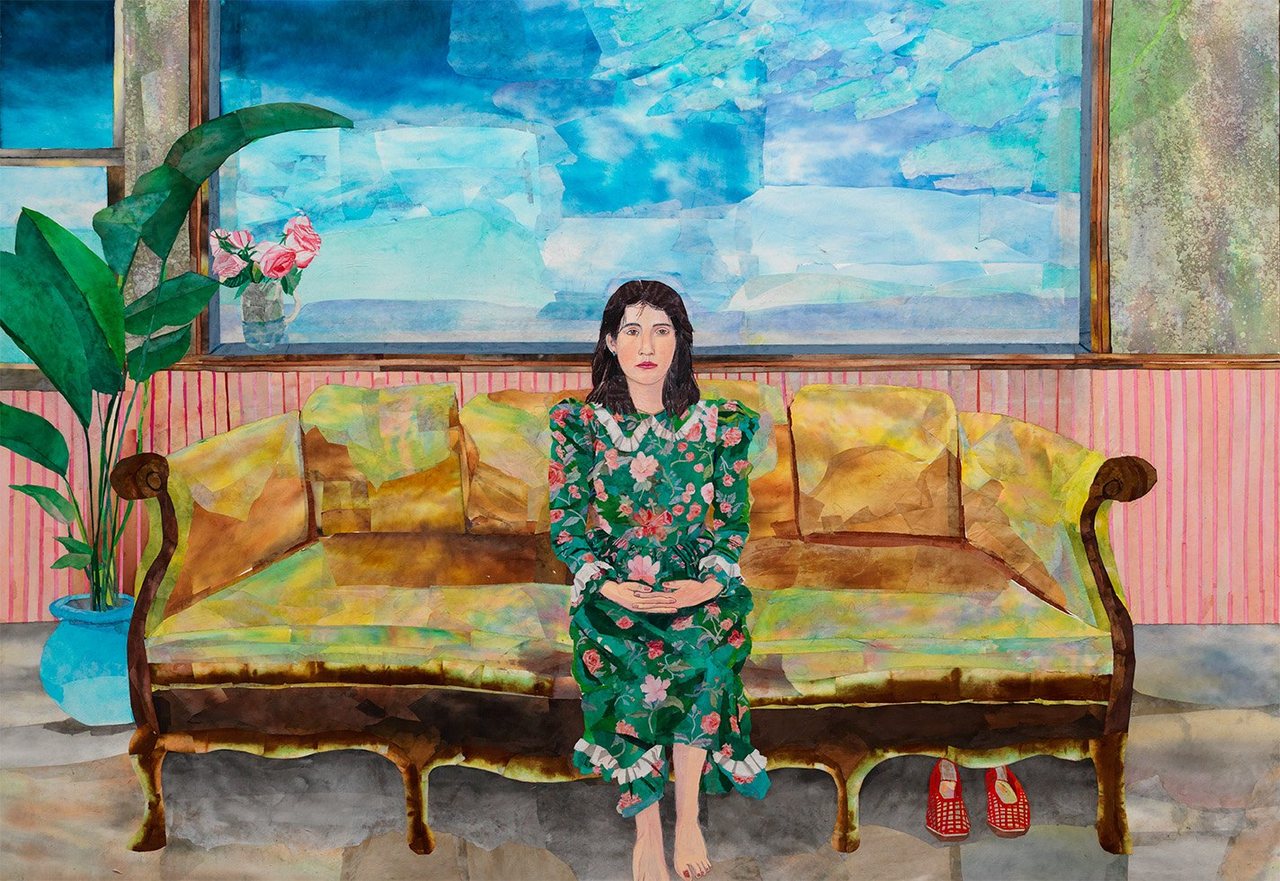
María Berrío, a Colombian-born artist living in New York, had wanted since childhood to add color to her drawings, but by her own account never fully mastered paint, and colored pencils did not interest her. Her solution was to “paint with paper.”
Her works, assembled from thousands of pieces of handmade Japanese washi paper, resemble paintings, some of them as vast as nineteenth-century history canvases. Each begins as a charcoal sketch, which she then fills in with bits of paper and touches of watercolor. Berrío switched to washi on the advice of a friend, the Japanese artist Yuriko Katori. Berrío says that this paper comes in an enormous range of colors and textures. Some kinds make it possible to create dense, crisp lines; others can be blended almost like paint.
The Minneapolis Institute of Art show, which brings together twenty works and is open through January 10, ranges from small hummingbird portraits to the huge “Ode to Hope,” in which eight women hold birds in their arms. It was made in 2019, when thousands of children were separated from their families at the U.S.-Mexico border. The women, as the artist conceived them, symbolize mothers and their hopes for their children’s future.
In the course of her work, the artist does not always stick strictly to her original charcoal sketch. She chooses the paper, cuts it with a utility knife and glues it down, applying the glue with a brush or simply with her fingers. Some sheets are so delicate that they require special techniques; others are so thick that each cut takes a fresh blade. “The material also has a number of limitations: it isn’t easy to lighten, blend or shade,” Berrío admits, “but part of the pleasure lies precisely in finding a way around those difficulties.”