Lycurgus Cup’s Secret Uncovered
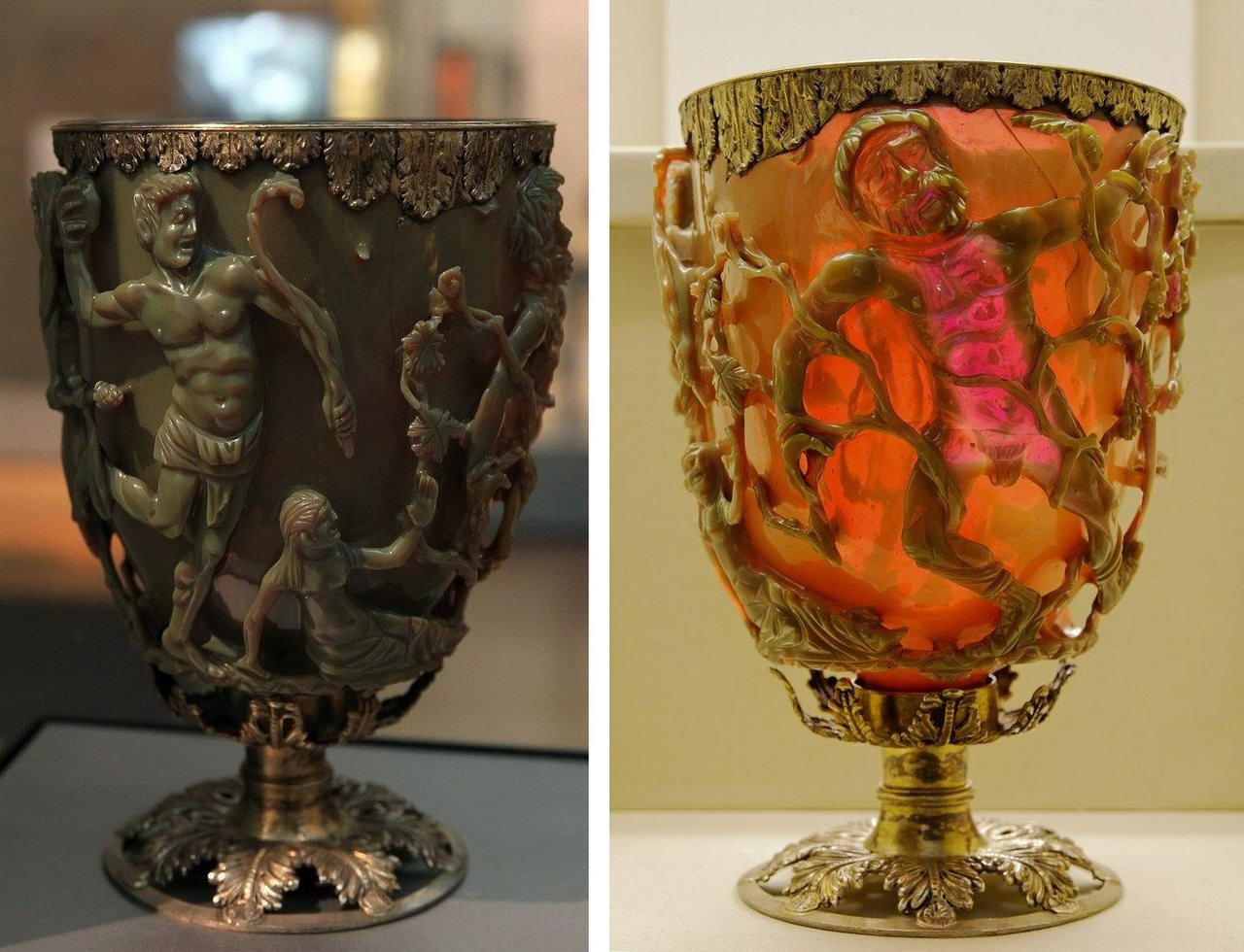
Scientists at the University of Sheffield have recreated an ancient Roman glass that changes its color from green to red. Their model, as The Guardian reports, was the Lycurgus Cup, a 4th-century vessel housed in the British Museum. The cup appears jade green in normal light, but turns ruby red when it is lit from behind.
The recipe for the glass was reconstructed from a fragment of the original. The color change is caused by nanoparticles of gold and silver: scientists created a glass melt at a temperature of over a thousand degrees, and as it cooled, nanocrystals of these metals grew inside it. These crystals block light in the blue and green parts of the spectrum, letting red and orange pass through, while scattering reflected light from the surface, which makes the glass appear green.
A similar effect was achieved back in the 1960s, but this is the first time the cup’s exact shades have been replicated with such precision. Ian Freestone, an honorary professor at University College London, noted that the color even depended on the glass’s position in the kiln. “This sensitivity suggests that it was very difficult for the Romans to control the color. I think with the Lycurgus Cup, they hit the jackpot,” he said.
The cup’s relief depicts the wine god Dionysus defeating King Lycurgus, who is being entangled in a grapevine. The color change is sometimes explained as representing the ripening of grapes, and the vessel itself may have been served at ritual feasts. Glass artist Elliot Walker has created a sculpture using the new technology; it will be displayed at Sheffield’s Millennium Gallery for a university festival from November 6 to 15, and then given to the Turner Museum of Glass.